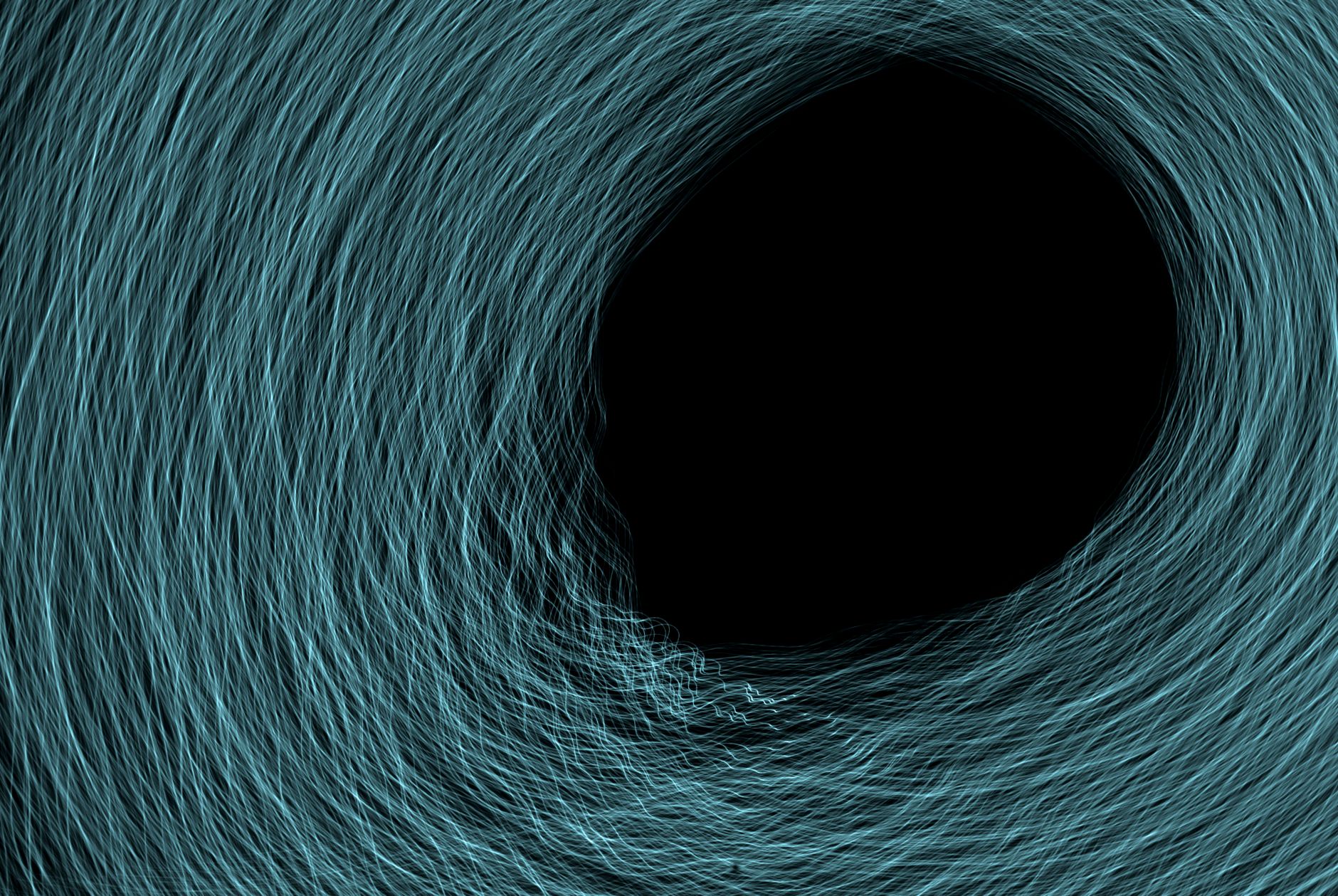
A black hole is a region in space where the gravitational pull is so strong that nothing, not even light, can escape. Recently, NASA’s Swift Observatory captured an ‘orphan’ black hole lighting up as it devoured a star on the outskirts of a faraway galaxy. This phenomenon is rare, occurring only once every 100,000 years, and is known as a tidal disruption event.
The black hole behind the blast weighs in at about a million times the Sun’s mass. Its existence was first flagged in November 2025 as an unusual brightening in a galaxy about 750 million light-years away by ZTF (Zwicky Transient Facility), a survey conducted by the Palomar Observatory in Southern California.
Black Hole Discovery
For a few months, the tidal disruption event outshone its entire host galaxy in ultraviolet wavelengths, temporarily radiating with the light of about 10 billion suns. This event was unusual because it occurred on the outskirts of a galaxy, rather than at its center, where supermassive black holes are typically found.
Researchers saw an ultrabright flare unleashed by a star being torn apart by extreme gravitational forces after drifting too close to a monster black hole. The combination of all this data helped scientists rule out other explanations and confidently say it’s a tidal disruption event, despite its strange location.
Tidal Disruption Events
Nearly every galaxy in the universe is anchored by a supermassive black hole sitting right in the center. About once every 100,000 years, a star will drift too close to this invisible heavyweight and trigger a tidal disruption event. While they’re rather rare in any given galaxy, scientists scour millions of galaxies for them.
Each year, astronomical surveys typically spot about 30 tidal disruption events occurring somewhere in the universe. Prior to 2024, they’d only been seen in galaxy cores. That’s partly because astronomers mainly looked for them there; after all, it’s where all the known supermassive black holes were, and you can’t get a tidal disruption event without one.
Searching for Black Holes
Astronomers have outlined two possibilities for the origin of the newfound black hole. Three or more galaxies may have merged together, and the gravitational tug-of-war between their central supermassive black holes may have flung the lightest black hole out to the galaxy’s edge. Or a dwarf galaxy could be midway through a merger.
- Galaxy mergers can lead to the formation of supermassive black holes
- Tidal disruption events can be used to detect black holes
- Astronomers are searching for more examples of out-of-place black holes
The answer to how common wandering black holes are may soon be within reach. Pointed science observations with Swift’s UVOT and XRT instruments are temporarily suspended as the mission awaits an orbit boost, which is planned for this summer.
Conclusion
In the coming years, scientists will use the new technique to search for disintegrating stars in observations from the newly operational Vera C. Rubin Observatory, jointly funded by the U.S. Department of Energy and National Science Foundation, in Chile and NASA’s upcoming Nancy Grace Roman Space Telescope. Adding their observations to Swift’s and those from ground-based observatories will bring astronomers closer than ever before to completing a census of the universe’s behemoth black holes.
Source: science.nasa.gov.






Be First to Comment