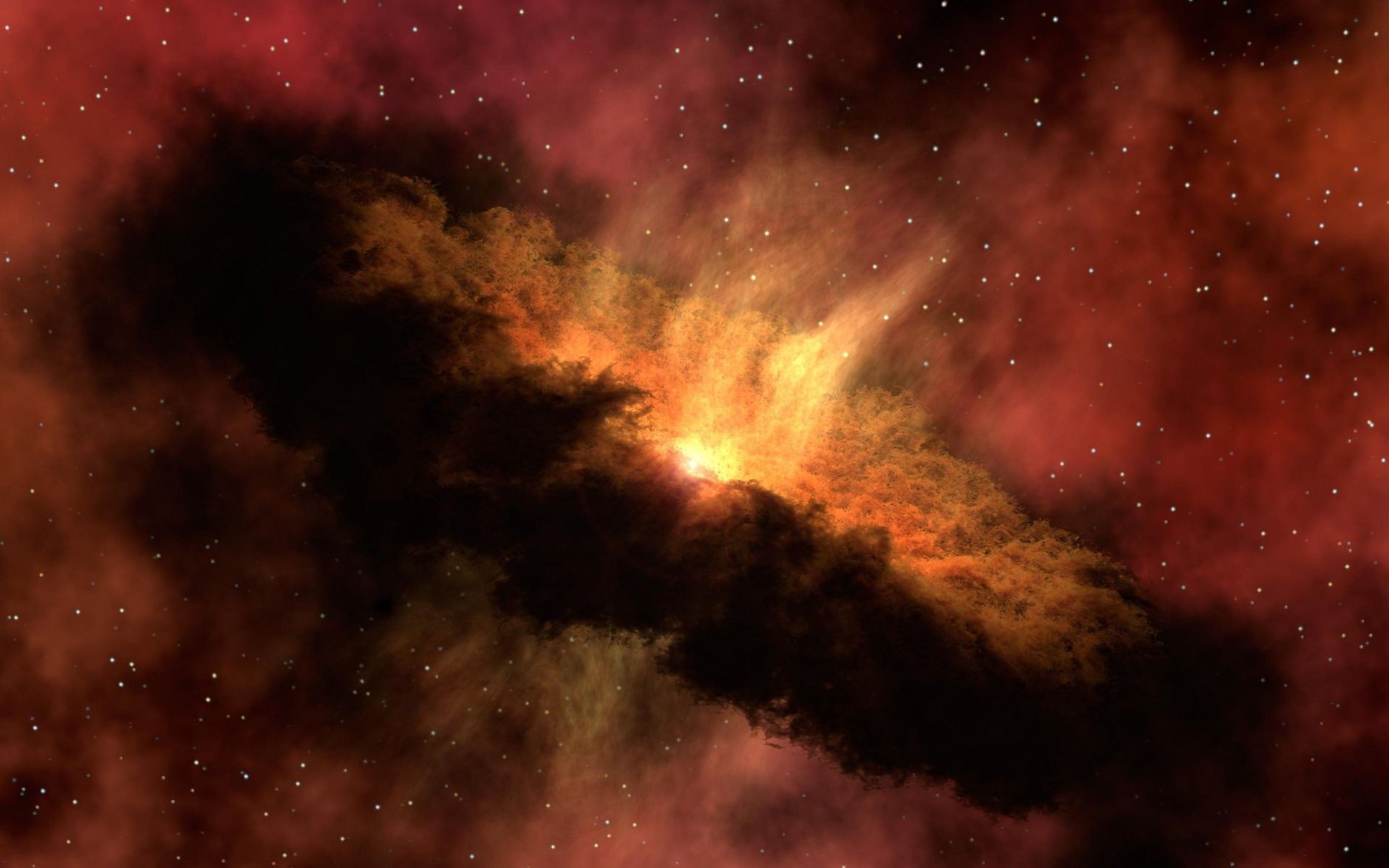
The stellar nursery LH 95, located in the Large Magellanic Cloud, is a region of intense star formation, with a thriving population of young stars heating and illuminating the surrounding gas and dust. This process creates a glowing landscape of gas and dust, with blue and white stars shining brilliantly against a crimson background.
The Large Magellanic Cloud is a dwarf galaxy that orbits the Milky Way, and it is home to many stellar associations, including LH 95. These associations are groups of stars that are born together and are held together by their mutual gravitational attraction.
Understanding Stellar Nurseries
Stellar nurseries like LH 95 are important for understanding the process of star formation. They provide a unique opportunity to study the early stages of star development, from the collapse of molecular clouds to the formation of protostars.
By studying stellar nurseries, astronomers can gain insights into the conditions that are necessary for star formation to occur. This knowledge can be used to better understand the formation of stars in other galaxies, as well as the formation of our own solar system.
The Role of Young Stars
Young stars play a crucial role in the formation of stellar nurseries. They are the primary source of energy for the surrounding gas and dust, and their radiation and strong winds help to shape the surrounding interstellar medium.
In the case of LH 95, the young stars are responsible for heating and illuminating the surrounding gas and dust, creating the glowing landscape that is visible in the Hubble Space Telescope image.
- Low-mass infant stars
- Massive blue giant stars
- Stellar associations
Implications and Questions to Watch
The study of stellar nurseries like LH 95 has important implications for our understanding of the universe. By studying the formation of stars in other galaxies, we can gain insights into the formation of our own solar system and the potential for life elsewhere in the universe.
There are still many questions to be answered, however, and further study is needed to fully understand the process of star formation. Some of the key questions to watch include: the role of magnetic fields in star formation, the impact of stellar feedback on the surrounding interstellar medium, and the formation of planetary systems around young stars.
Conclusion
In conclusion, the stellar nursery LH 95 is a fascinating region of intense star formation, with a thriving population of young stars heating and illuminating the surrounding gas and dust. By studying this region and others like it, astronomers can gain insights into the process of star formation and the formation of our own solar system.
Source: nasa.gov.






Be First to Comment