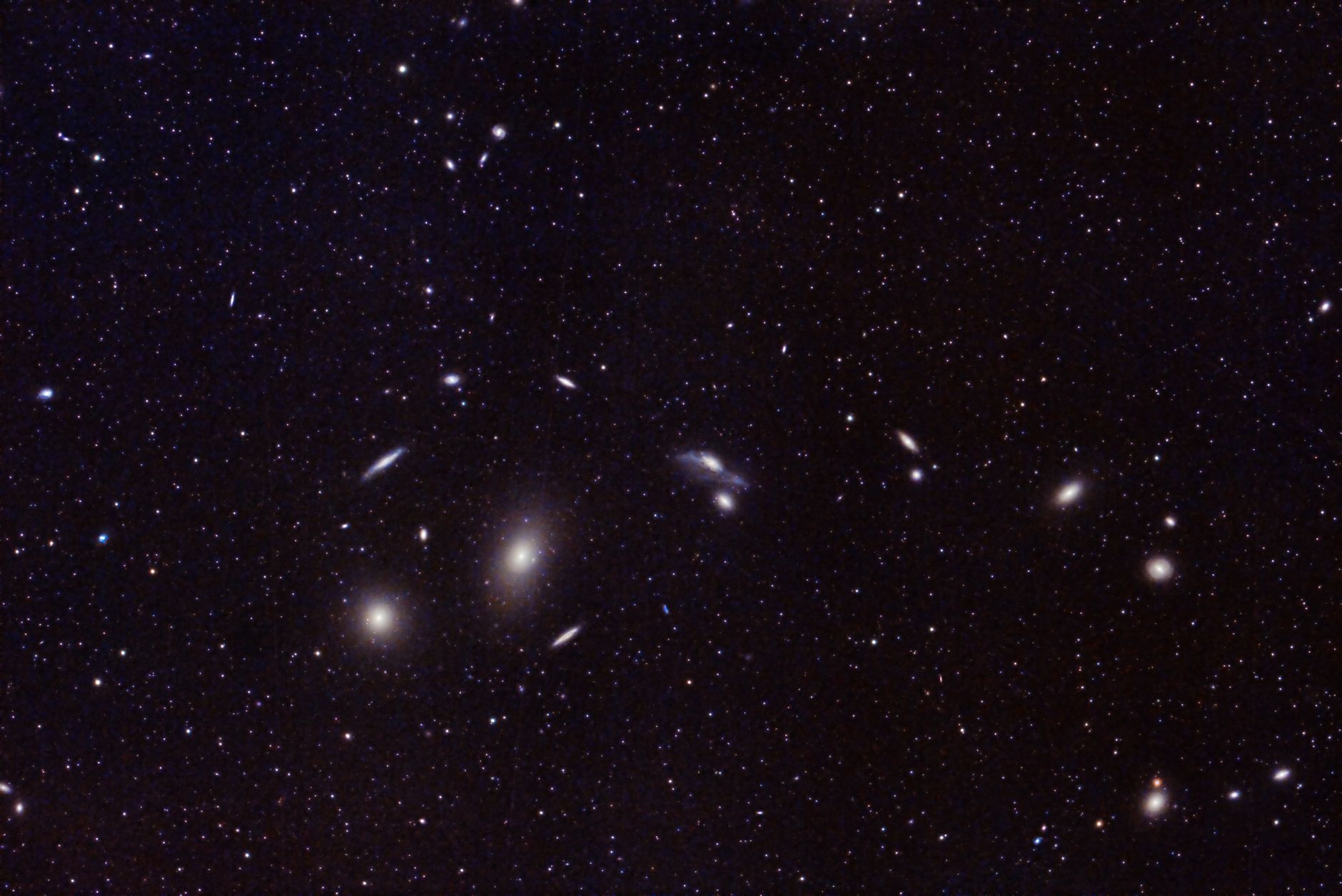
The Hubble Space Telescope has made another groundbreaking discovery, capturing a breathtaking image of the galaxy cluster MACS0329-0211. This phenomenon is a treasure trove of information, providing insights into the universe’s structure and evolution.
Understanding Galaxy Clusters
Galaxy clusters like MACS0329-0211 are the largest known structures in the universe, comprising hundreds to thousands of galaxies bound together by gravity. These clusters are not only impressive in scale but also play a crucial role in our understanding of the cosmos. They serve as signposts, marking the path of the universe’s evolution and offering a glimpse into its distant past.
The image of MACS0329-0211, taken by Hubble’s Advanced Camera for Surveys and Wide Field Camera 3, showcases a diverse range of galaxies. From large, oval-shaped elliptical galaxies to thin spiral and lenticular galaxies, the cluster is a marvel of celestial diversity. The image also features the full, face-on view of spiral galaxies, complete with their curving spiral arms.
Gravitational Lensing: A Cosmic Magnifying Glass
The gravity of the galaxy cluster is so strong that it warps the light passing through it, creating a phenomenon known as gravitational lensing. This effect allows us to see distant galaxies that would otherwise be invisible, placing them in our view like a cosmic magnifying glass. The image’s upper-right quadrant features faint arcs of distant galaxies, gravitationally lensed by the cluster’s massive gravity.
Closer inspection of the image’s center reveals several bright-white intersecting curves, resembling a distorted figure eight. This may be another distant galaxy whose light was magnified and distorted by the cluster’s gravity. The ability to observe such phenomena is a testament to Hubble’s incredible capabilities and its role in advancing our understanding of the universe.
Hubble’s Role in Understanding the Universe
The Hubble Space Telescope has been a cornerstone of astronomical research since its launch in 1990. With its ability to capture a broad spectrum of light, from visible to infrared, Hubble has revolutionized our understanding of the universe. From the formation of stars and galaxies to the expansion of the cosmos itself, Hubble has provided invaluable insights into the workings of the universe.
The observation of MACS0329-0211 is part of a larger program to study X-ray bright galaxy clusters. By examining these clusters, researchers can gain a deeper understanding of the universe’s structure and evolution. The data gathered by Hubble will be used to refine our knowledge of the cosmos, shedding light on the mysteries that still surround us.
Looking to the Future
As we continue to explore the universe, discoveries like the galaxy cluster MACS0329-0211 remind us of the awe-inspiring complexity and beauty of the cosmos. The Hubble Space Telescope has been a faithful companion on this journey, providing us with breathtaking images and invaluable data. As we look to the future, it is clear that the study of the universe will continue to be an exciting and rewarding field, full of mysteries waiting to be unraveled.
- The Hubble Space Telescope has been in operation since 1990.
- Galaxy clusters are the largest known structures in the universe.
- Gravitational lensing allows us to see distant galaxies that would otherwise be invisible.
The image of MACS0329-0211 is a powerful reminder of the importance of continued exploration and research into the universe. As we continue to push the boundaries of human knowledge, we may uncover even more secrets of the cosmos, revealing the intricate beauty and complexity of the universe.
Source: science.nasa.gov.






Be First to Comment