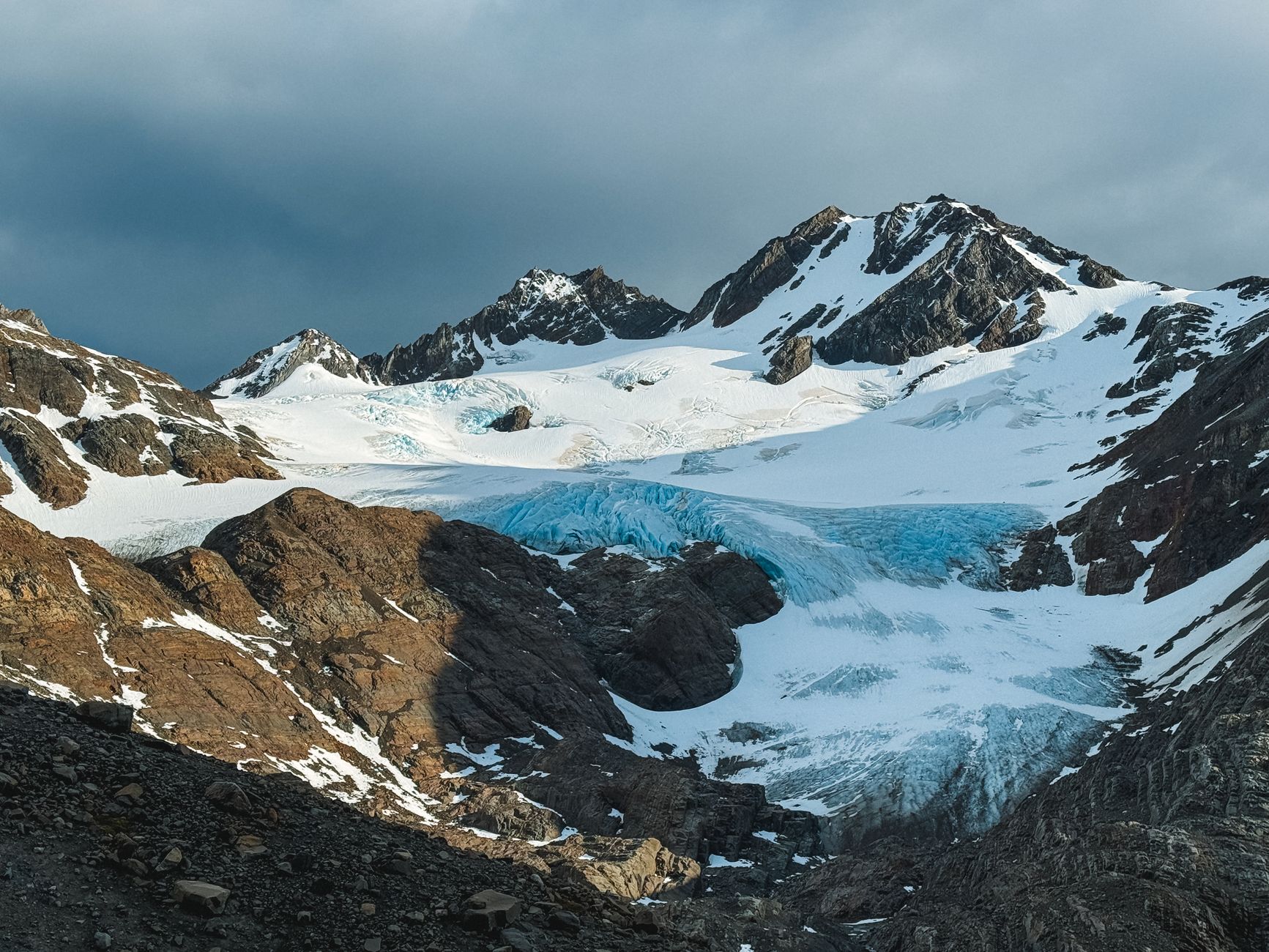
The Southern Patagonian Icefield, the largest expanse of ice in the Southern Hemisphere outside of Antarctica, is home to dozens of dynamic outlet glaciers, including the Tyndall Glacier in southern Chile. This glacier has been the subject of much attention in recent years due to its rapid decline.
Background and History
The Tyndall Glacier has been shrinking since the end of the Little Ice Age, about 150 years ago. The glacier’s terminus, or end point, was once located in Lago Tyndall to the east, but due to thinning ice, this outlet was cut off by 2010. The glacier’s retreat has also exposed bedrock along its eastern edge, containing scores of ichthyosaur fossils.
In recent years, the glacier has experienced significant calving events, with large icebergs breaking away from its terminus. In March and April 2023, a major calving event occurred, resulting in the loss of a substantial amount of ice. This event, combined with the glacier’s ongoing thinning, has contributed to its rapid decline.
Current State and Projections
According to glaciologist Mauri Pelto, the Tyndall Glacier has lost 2.2 kilometers (1.4 miles) in length since November 2022. The glacier’s front is currently estimated to be around 30-40 meters (100-130 feet) above the lake surface. Pelto expects that the glacier will continue to experience significant calving events, with many small icebergs breaking off in the coming months.
The substantial crevasses crisscrossing the glacier near the calving front are a major contributor to the formation of smaller icebergs. In contrast, larger tabular icebergs tend to form when there are fewer deep crevasses near the terminus and the glacier’s ice is thinner.
Monitoring and Understanding Glaciers
Observations from orbit, including astronaut photographs, play a crucial role in monitoring and understanding glaciers in remote regions. The International Space Station Program supports the laboratory as part of the ISS National Lab, allowing astronauts to take pictures of Earth that will be of the greatest value to scientists and the public.
The image of the Tyndall Glacier, taken by an astronaut on May 10, 2026, provides valuable insights into the glacier’s current state. The image shows fragments of ice that have calved off the glacier’s terminus, floating on Lago Geikie. The glacier’s ice cliff at the terminus casts a substantial shadow, which can help scientists estimate the height of the glacier’s front.
Implications and Future Research
The rapid decline of the Tyndall Glacier has significant implications for our understanding of glacier dynamics and the impacts of climate change. Further research is needed to understand the factors contributing to the glacier’s decline and to predict its future behavior.
Some of the key questions to watch include: What are the main drivers of the Tyndall Glacier’s decline? How will the glacier’s retreat affect the surrounding ecosystem? What can be done to mitigate the impacts of climate change on glaciers like the Tyndall Glacier?
- Continued monitoring of the glacier’s state and behavior
- Further research into the factors contributing to the glacier’s decline
- Development of strategies to mitigate the impacts of climate change on glaciers
The story of the Tyndall Glacier serves as a reminder of the importance of continued research and monitoring of glaciers, as well as the need for urgent action to address the impacts of climate change.
The Earth Observatory and NASA will continue to provide updates on the Tyndall Glacier and other glaciers around the world, as well as insights into the latest research and discoveries in the field of glaciology.
Source: science.nasa.gov.






Be First to Comment