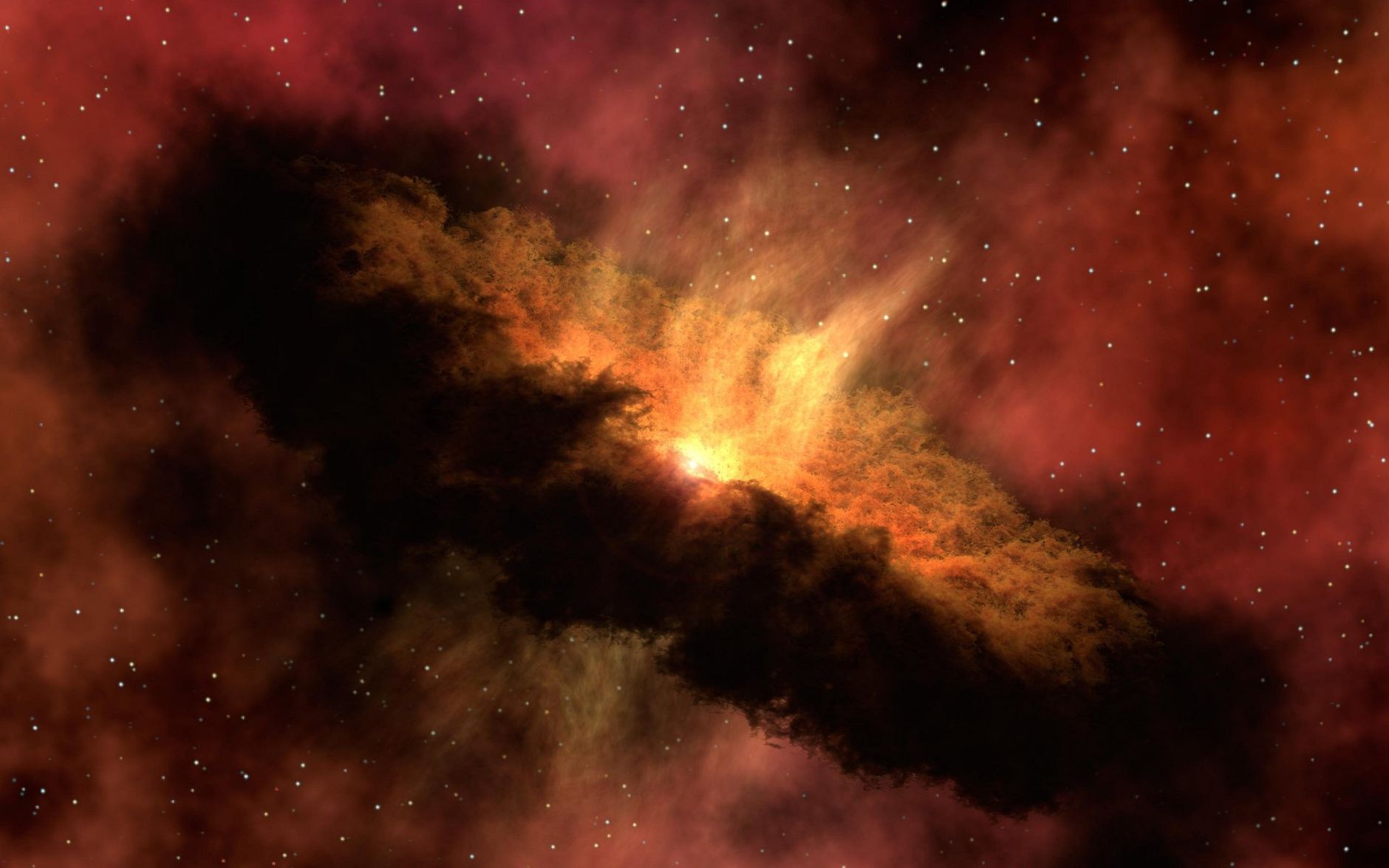
NASA’s James Webb Space Telescope has captured the infrared light of numerous features that previously were impossible to see beyond the thick dust of the FS Tau star system. Star formation is a complex process that involves the collapse of dense pockets of gas and dust. In the FS Tau star system, the James Webb Space Telescope has revealed bright protostars and a tapestry of background galaxies.
The protostars of FS Tau are about 1 to 3 million years old, which is relatively young in cosmic scales. Our Sun, by contrast, is 4.6 billion years old. The James Webb Space Telescope is the world’s premier space science observatory, and it is solving mysteries in our solar system, looking beyond to distant worlds around other stars, and probing the mysterious structures and origins of our universe and our place in it.
Star Formation and the James Webb Space Telescope
The James Webb Space Telescope is an international program led by NASA with its partners, ESA and CSA. The telescope is designed to study the formation of stars and planets, as well as the composition of the atmospheres of distant planets. In the case of the FS Tau star system, the James Webb Space Telescope has revealed a pair of protostars that creates the largest diffraction pattern seen slightly to the left of center in the image.
These protostars are about half the mass of our Sun, and they are still in the process of forming. The James Webb Space Telescope has also revealed the outflows of gas and dust that are emitted by the protostars as they grow. These outflows are thought to come from the interaction between the protostar’s magnetic field and superheated matter closest to the protostar within its accretion disk.
The Importance of Star Formation
Star formation is a crucial process in the universe, as it is the mechanism by which new stars are created. The study of star formation is important for understanding the evolution of galaxies and the formation of planetary systems. The James Webb Space Telescope is providing new insights into the process of star formation, and it is helping scientists to better understand the complex interactions between gas, dust, and magnetic fields that occur during this process.
- Star formation is a complex process that involves the collapse of dense pockets of gas and dust.
- The James Webb Space Telescope is the world’s premier space science observatory, and it is designed to study the formation of stars and planets.
- The telescope has revealed bright protostars and a tapestry of background galaxies in the FS Tau star system.
Conclusion
In conclusion, the James Webb Space Telescope has revealed new insights into the process of star formation in the FS Tau star system. The telescope has captured the infrared light of numerous features that previously were impossible to see beyond the thick dust of the star system. The study of star formation is important for understanding the evolution of galaxies and the formation of planetary systems, and the James Webb Space Telescope is providing new insights into this complex process.
Future Research Directions
Future research directions for the study of star formation include the use of new telescopes and instruments to study the formation of stars and planets. The James Webb Space Telescope is just one of many telescopes that are being used to study the universe, and it is providing new insights into the process of star formation. As scientists continue to study the universe, they are likely to learn more about the complex interactions between gas, dust, and magnetic fields that occur during the process of star formation.
Source: science.nasa.gov.






Be First to Comment